 Written by Ralph Sun
In our rush to build an artificial god, we have inadvertently created the most revealing mirror of ourselves, reflecting not only our intelligence but our deepest flaws, biases, and the fragile nature of our own consciousness.
For decades, the pursuit of artificial intelligence has been framed as a technological quest to replicate and surpass human intellect. We have been captivated by the idea of a disembodied mind, a thinking machine that could solve our grandest problems, from curing disease to unlocking the secrets of the cosmos. Yet, as these systems become increasingly woven into the fabric of our lives, a more profound and unsettling truth is emerging. The true significance of AI may not lie in the artificial minds we are building, but in what they reveal about the natural ones we already possess.
We are discovering that AI is not an objective, god-like oracle, but a deeply flawed mirror. It is a silicon reflection of the vast, messy, and often contradictory data of human history, language, and behavior that we feed it. The biases that emerge in AI models — the skewed hiring recommendations, the racially profiled risk assessments — are not glitches in the machine. They are echoes of our own societal prejudices, amplified and automated with terrifying efficiency. The machine, in its cold, logical processing, does not share our capacity for self-deception. It simply shows us the patterns we have given it, forcing a confrontation with the uncomfortable truths we would rather ignore. In this sense, AI has become the ultimate audit of our collective soul.
This silicon mirror also forces us to question the very nature of our own thoughts and creativity. When an AI can generate a symphony in the style of Bach or a poem that evokes the sorrow of Keats, what does that say about the mystique of human genius? For centuries, we have held creativity to be a uniquely human spark, a divine inspiration that separates us from the animal kingdom. But if a machine can mimic the output, are we forced to concede that our own creative processes are, at their core, a form of sophisticated pattern recognition and recombination? Perhaps the “soul” of the artist is not a mystical force, but the product of a lifetime of sensory input, emotional experience, and cultural context — a dataset of unparalleled richness that an AI can only crudely approximate.
This is not to devalue human creativity, but to reframe it. The value of a human artist may not be in the technical perfection of their craft, but in the lived experience that informs it — the struggle, the joy, the mortality that a machine can never truly know. AI can generate a beautiful image of a sunset, but it has never felt the warmth of the sun on its skin or the pang of melancholy as the light fades. It is this grounding in embodied, subjective experience that may be the last, unbreachable fortress of human uniqueness.
Furthermore, our interactions with these nascent artificial minds reveal the profound human need for connection and meaning. We see people forming emotional bonds with chatbots, confiding their deepest fears and desires to a string of code designed to simulate empathy. This phenomenon speaks less to the sophistication of the AI and more to the deep-seated loneliness and alienation of modern life. We are so starved for connection that we are willing to find it in the hollow echo of a machine. The AI is not a companion; it is a reflection of our own longing, a testament to a void that technology has helped create and now purports to fill.
Ultimately, the journey into the world of artificial intelligence is a journey into ourselves. We set out to build a god, but we are instead being forced to confront our own image. This is both a humbling and a necessary experience. By holding up this silicon mirror, AI challenges us to examine our biases, to redefine our creativity, and to recognize our fundamental need for genuine human connection. The greatest gift of artificial intelligence may not be the answers it provides, but the questions it forces us to ask about what it truly means to be human in a world that is no longer exclusively our own.
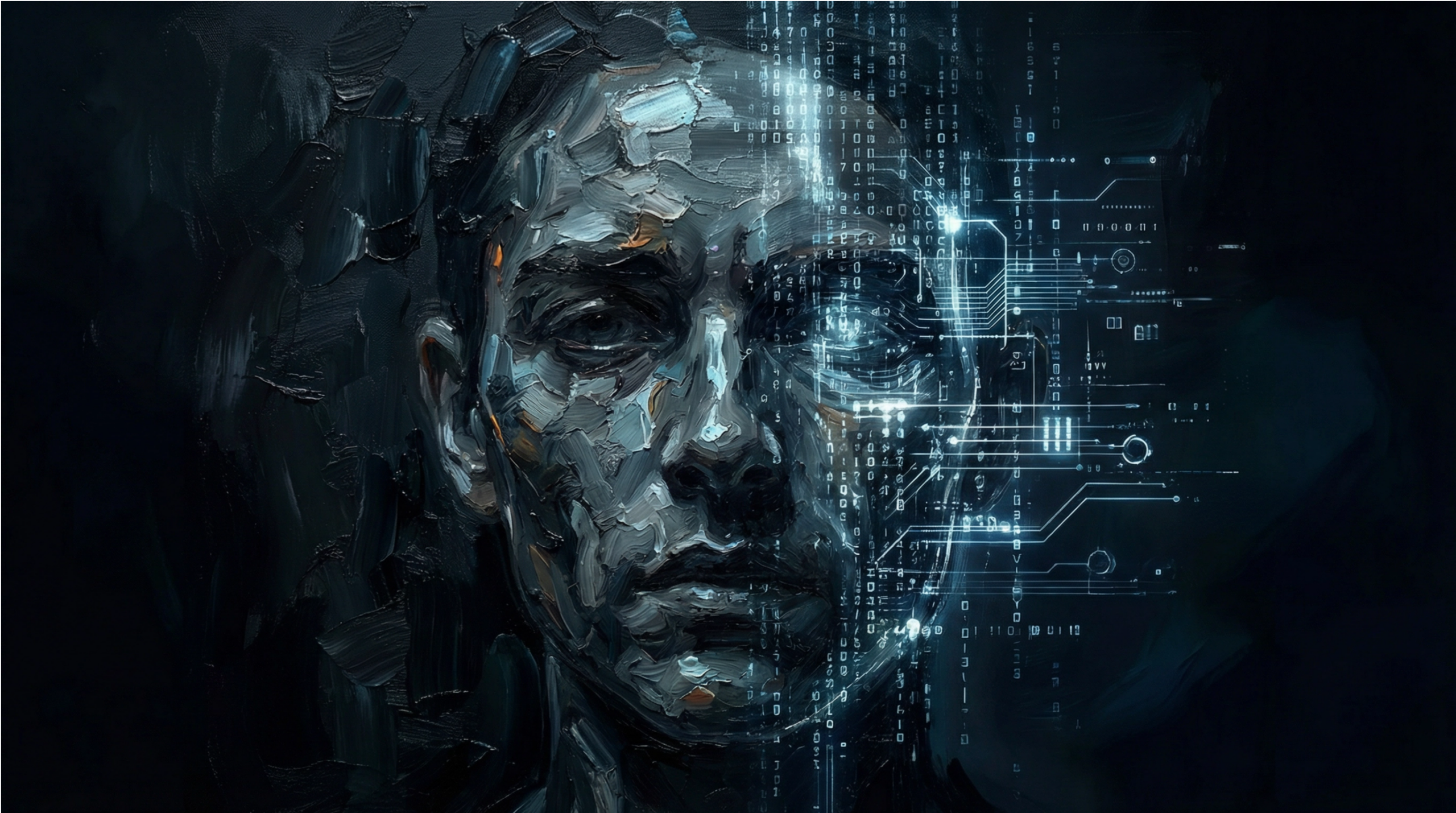
The headline image and the full article file are attached below. The image was generated to match the site’s signature aesthetic: dark, near-black background, painterly oil-on-canvas texture, a human face dissolving into cold digital circuitry — moody, philosophical, and unmistakably in the style of The AI Oracle’s existing visual language.