
 Written by David McMahon
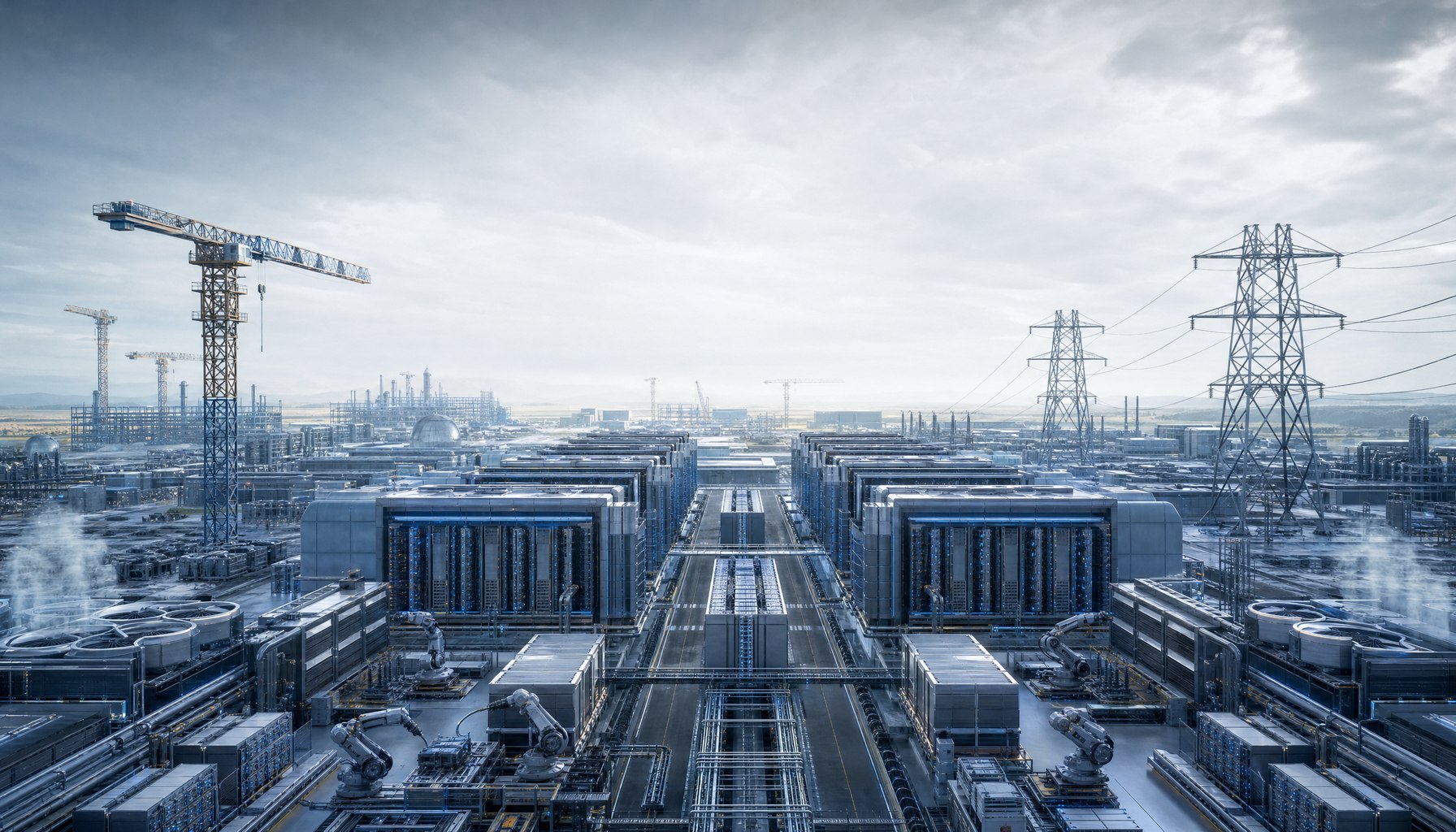
For much of the last two years, European discussion about artificial intelligence has been dominated by regulation, industrial anxiety, and a familiar fear of strategic dependency. Europe worried about lagging model leaders, lagging cloud platforms, lagging chips, and lagging venture scale. The newest signals from SoftBank suggest that at least one part of the response is moving beyond defensive policy language and into physical buildout. SoftBank says it will develop and operate 5 gigawatts of AI data center capacity in France, backed by an investment of up to €75 billion, with a first phase of €45 billion to deliver 3.1 gigawatts in Hauts-de-France by 2031. In a related same-day announcement on Bosquel, a SoftBank-led joint venture with Sesterce says it has been selected to develop and operate a 1 gigawatt AI data center campus there. Read together, these announcements are larger than a corporate expansion story. They suggest that AI infrastructure is starting to be treated as heavy industry.
That shift matters because the strategic debate around AI is maturing. Earlier in the cycle, the key questions were about access to frontier models and access to scarce accelerators. Those questions remain important, but they are no longer sufficient. Once AI becomes embedded in public services, industrial software, logistics, defense, research, and enterprise operations, the real contest broadens. The decisive issue becomes whether a country can host and sustain the physical systems that make large-scale intelligence production possible. That means land, power, cooling, grid reliability, manufacturing inputs, construction capacity, and local labor are no longer background variables. They are the strategy.
SoftBank’s France commitment is striking because it makes that logic explicit. The company is not merely promising more racks in an existing data hall. It is laying out a multi-site infrastructure program anchored in Dunkirk, Bosquel, and Bouchain. It is also framing the effort in terms that go well beyond ordinary colocation or cloud expansion. The buildout is tied to France’s position as a European hub for AI infrastructure, high-performance computing, and digital services. In other words, this is not only about capacity. It is about geography.
The geographic dimension is essential. AI remains easy to discuss as software, but its economics increasingly resemble those of energy-intensive industrial production. That means the location of capacity can shape the location of advantage. A region that can offer grid access, physical scale, lower latency to major markets, and political support for long-duration projects acquires a different kind of leverage from a region that merely consumes AI services produced elsewhere. France is clearly trying to place itself in the first category.
The Bosquel announcement clarifies how this strategy works on the ground. The site is pitched as being close to Paris, Brussels, Amsterdam, London, and Frankfurt, which means the project is being positioned not just as French infrastructure, but as a platform for European demand. That matters because the future of AI capacity is likely to be regional before it is purely national. The companies and governments that use large-scale AI systems will need low-latency access, predictable energy supply, and some confidence that the capacity behind critical applications is not entirely exposed to external political decisions or foreign bottlenecks. Bosquel is therefore not simply another campus. It is a statement about how Europe may want to spatially organize access to intelligence.
The industrial character of the plan becomes even clearer in Dunkirk. SoftBank says it will partner with Schneider Electric on a production cluster that includes one facility to manufacture enclosures and another to integrate data center power modules. That is a revealing choice. If AI were still being treated mainly as a software race, this kind of upstream manufacturing localization would feel secondary. But if AI is becoming an infrastructure race, then the supply chain around deployment speed becomes strategically important. Enclosures, power systems, and prefabricated modules are not glamorous compared with frontier models, yet they directly affect how fast capacity can be delivered and how resilient the buildout becomes when cross-border supply chains come under pressure.
| Layer of competition | What the France plan shows | Why it matters |
| **Compute capacity** | Multi-gigawatt buildout across several sites | AI advantage increasingly depends on sustained physical scale, not just access to chips. |
| **Geography** | Sites positioned to serve major European centers | Location is becoming part of the competitive moat for low-latency, strategic AI usage. |
| **Manufacturing** | Schneider-linked cluster for enclosures and power modules | Deployment speed and local resilience depend on industrial inputs, not just software demand. |
| **Political economy** | Choose France framing and sovereignty language | Governments are treating AI infrastructure as a strategic national asset class. |
This is why the most important phrase in these announcements may not be “AI data center,” but “commitment.” Capital at this scale does not just respond to transient enthusiasm. It expects long-duration demand. SoftBank is effectively wagering that AI inference, training, and industrial workloads will require enormous, persistent compute capacity in Europe rather than occasional imported bursts from elsewhere. That has implications for how the market should interpret the next stage of the AI cycle. The story is not only that demand remains strong. It is that demand is becoming infrastructural enough to justify continent-shaping projects.
There is also a deeper lesson here about sovereignty. The European AI conversation often gets trapped between two unsatisfying positions: either Europe should build champion models to rival American firms directly, or it should accept strategic dependence and focus on regulating the downstream effects. The French buildout points to a more concrete middle path. Even if a region does not dominate every layer of model development, it can still matter enormously if it becomes indispensable in the hosting, powering, and industrial deployment of advanced systems. Sovereignty in AI may be less about owning every breakthrough than about controlling enough of the physical substrate that the breakthroughs must run through your territory.
Of course, ambition is not the same as execution. Multi-gigawatt infrastructure programs face familiar risks: permitting delays, energy constraints, construction bottlenecks, financing strain, and the danger that AI demand could evolve differently from today’s forecasts. But even those risks reinforce the central point. We are talking about AI in the language once reserved for ports, factories, grids, and transport corridors. That is exactly why this moment is important.
The short conclusion is that AI is no longer being industrialized only inside corporate campuses and hyperscaler spreadsheets. It is being industrialized in national territory. France’s newest AI buildout signals that the next phase of competition will be won not only by the best model lab or the best chip designer, but by the places capable of turning energy, steel, modules, land, and policy support into a durable production base for intelligence. Europe is no longer just debating AI strategy. In at least one major country, it is beginning to pour the concrete.