
 Written by David McMahon
For much of the generative AI boom, the industry behaved as though its future would be determined by a single question: who could secure the most advanced accelerators. That framing made sense when the dominant constraint was training frontier models and when competitive advantage appeared to rest on access to scarce GPUs. But the latest announcements from Intel and NVIDIA suggest that the center of gravity is moving. As AI applications leave the lab and enter production, the decisive issue is no longer raw chip possession alone. It is whether companies can build economical, coordinated, rack-scale systems optimized for inference, orchestration, and continuous deployment.
Intel’s newest Computex message is notable not because it claims a sudden reversal in the GPU hierarchy, but because it explicitly redefines the problem. The company argues that as AI workloads move into production, demand is rising for cost-effective, power-efficient inference, and that the emergence of agentic AI is returning the CPU to a more prominent role in the data center. That is a significant shift in emphasis. Training remains important, but inference is where commercial workloads become repetitive, latency-sensitive, and financially consequential. Once enterprises begin running agentic systems at scale, the priority changes from peak model spectacle to throughput, concurrency, predictability, and cost discipline.
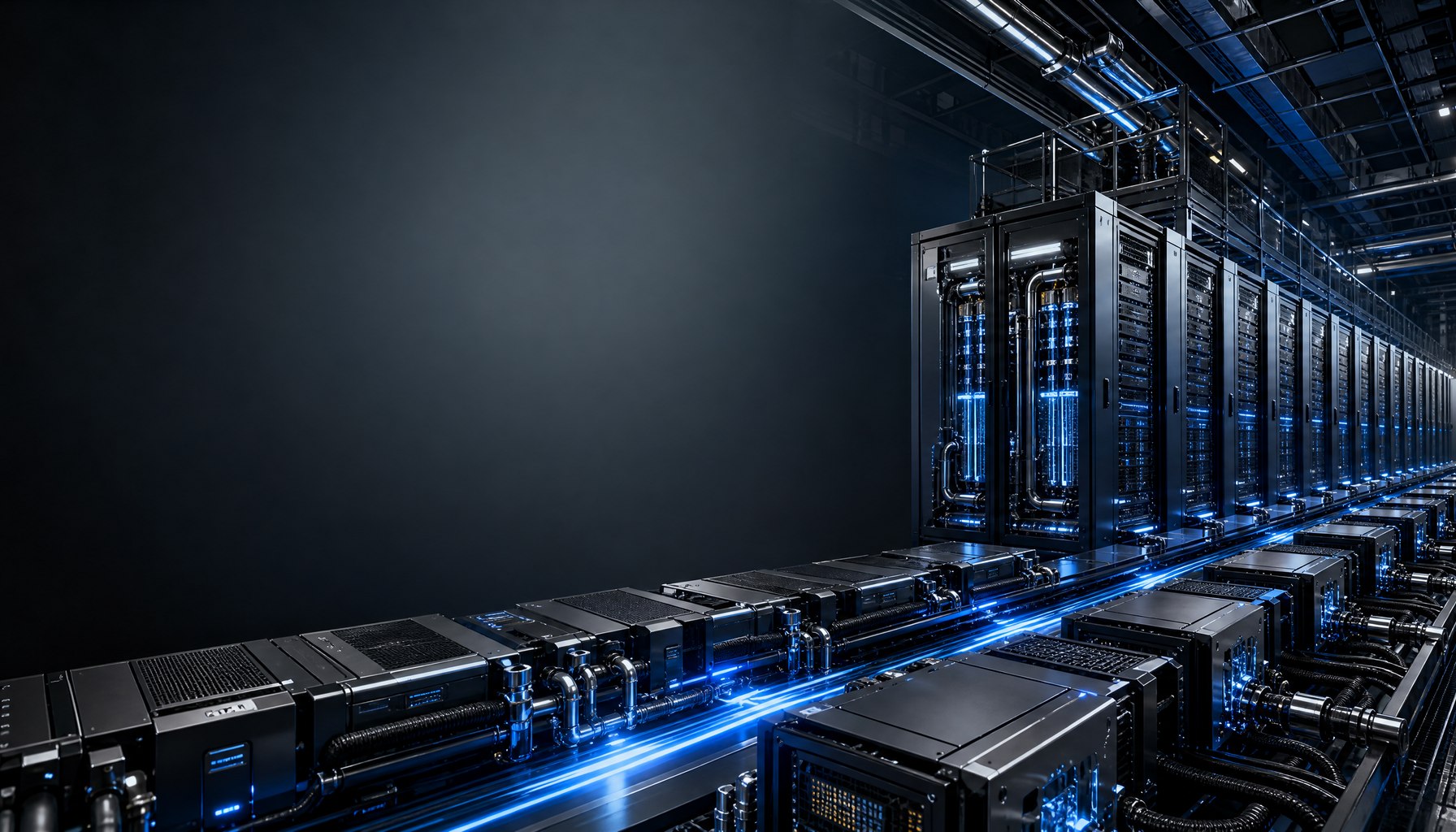
Intel’s argument becomes more persuasive when it is tied to system design rather than processor marketing. The company announced rack-scale AI infrastructure for data center, hyperscale, and intelligence-center deployments in collaboration with SambaNova and Foxconn, all built on Intel Xeon processors. Foxconn’s role is especially revealing. It is not being positioned merely as a contract manufacturer at the edge of the story, but as a provider of system integration capabilities for the new infrastructure. It also plans a CPU-dense variant for cost-optimized inference, data processing, and hybrid AI workloads. In other words, the competitive frontier is moving toward the architecture of the rack itself: how compute, acceleration, orchestration, cooling, and manufacturing discipline come together in one deployable unit.
That helps explain why Intel highlighted a statistic that would have sounded almost peripheral a year ago. It says a single liquid-cooled rack using Xeon 6+ can deliver 36,864 cores in 32U of compute space at roughly 100 kilowatts of rack power. The point is not simply that this is a large number. The point is that AI infrastructure is being described in the language of density, thermals, utilization, and service economics. Those are factory metrics. They matter because inference at scale does not reward theoretical superiority alone; it rewards architectures that can be deployed, cooled, maintained, and amortized across a growing mix of enterprise and agentic workloads.
Intel’s citation of analyst Ben Bajarin reinforces the same trend. In his framing, the old training-era deployment ratio looked closer to one CPU for four GPUs, while agentic inference pushes that relationship toward something closer to one CPU for one GPU or less. Whether that ratio holds universally is less important than what it signals. If agentic AI raises the value of orchestration, scheduling, memory movement, and general-purpose control, then the CPU returns not as a nostalgic incumbent but as a strategic coordinator inside a more complicated machine. AI infrastructure stops being a story about one dominant chip and becomes a story about system balance.
NVIDIA’s own messaging, interestingly, does not contradict this. It strengthens it. The company’s latest ecosystem announcement says its AI cloud partners are accelerating the global buildout of AI factory infrastructure to meet demand from enterprises, startups, nations, AI labs, and developers scaling agentic AI applications. That wording matters because it shows the market broadening beyond a narrow circle of frontier model builders. Once the customer base expands, the infrastructure challenge changes with it. The task is no longer only to train the biggest model; it is to supply a diverse market with usable, reliable, interoperable compute.
NVIDIA also underscored Taiwan’s role in this industrial transition, saying the island is home to more than 500 ecosystem partners and that more than 1 million MGX rack components for Vera Rubin infrastructure come together there across 25 factory sites. This is not just a supply-chain detail. It is evidence that AI is becoming a manufacturing system with distributed production nodes, partner coordination, and a deep dependence on assembly competence. The mythology of AI often presents progress as the output of singular labs and singular models. The material reality looks more like industrial coordination at enormous scale.
| Shift | What the latest announcements show | Strategic consequence |
| **From training to inference** | Intel emphasizes cost-efficient, power-efficient inference as AI moves into production | Commercial AI competition is increasingly about operating economics, not just model creation. |
| **From chips to racks** | Intel, SambaNova, and Foxconn are framing AI infrastructure as a rack-scale systems problem | Integration quality and deployment discipline become competitive variables. |
| **From hyperscalers to ecosystems** | NVIDIA describes demand from enterprises, startups, nations, labs, and developers | Broader adoption increases the value of interoperable, scalable infrastructure platforms. |
| **From scarcity to industrialization** | NVIDIA highlights 500-plus partners and more than 1 million MGX components across 25 sites in Taiwan | AI capacity is becoming an industrial manufacturing network, not just a chip allocation game. |
This is why the latest AI developments should be read less as a vendor skirmish and more as a structural transition. The industry is not moving beyond accelerators; it is moving beyond the belief that accelerators alone explain value creation. Inference-heavy, agentic, always-on AI requires a different stack of priorities: orchestration, balance, system density, cooling, partner manufacturing, and the ability to convert component inventories into stable service delivery. That does not diminish the importance of leading silicon. It puts that silicon back into context.
There is also a financial implication hidden inside the engineering language. Infrastructure optimized for inference and agentic execution is likely to favor organizations that can manage utilization carefully and deploy modular capacity rather than merely accumulate expensive hardware. In that world, the winners may not be those that shout the loudest about peak compute, but those that can turn heterogeneous components into predictable output at acceptable cost. The discipline looks less like speculative scaling and more like modern industrial operations.
The newest announcements therefore point to a clearer definition of the next AI phase. The industry is becoming a systems business. Chips remain essential, but they are now part of a larger contest over rack design, infrastructure economics, production partnerships, and the operational logic of inference at scale. The AI era will still be measured by models and benchmarks. But increasingly, it will be decided by who can build a machine around them that actually works in production.