
 Written by David McMahon
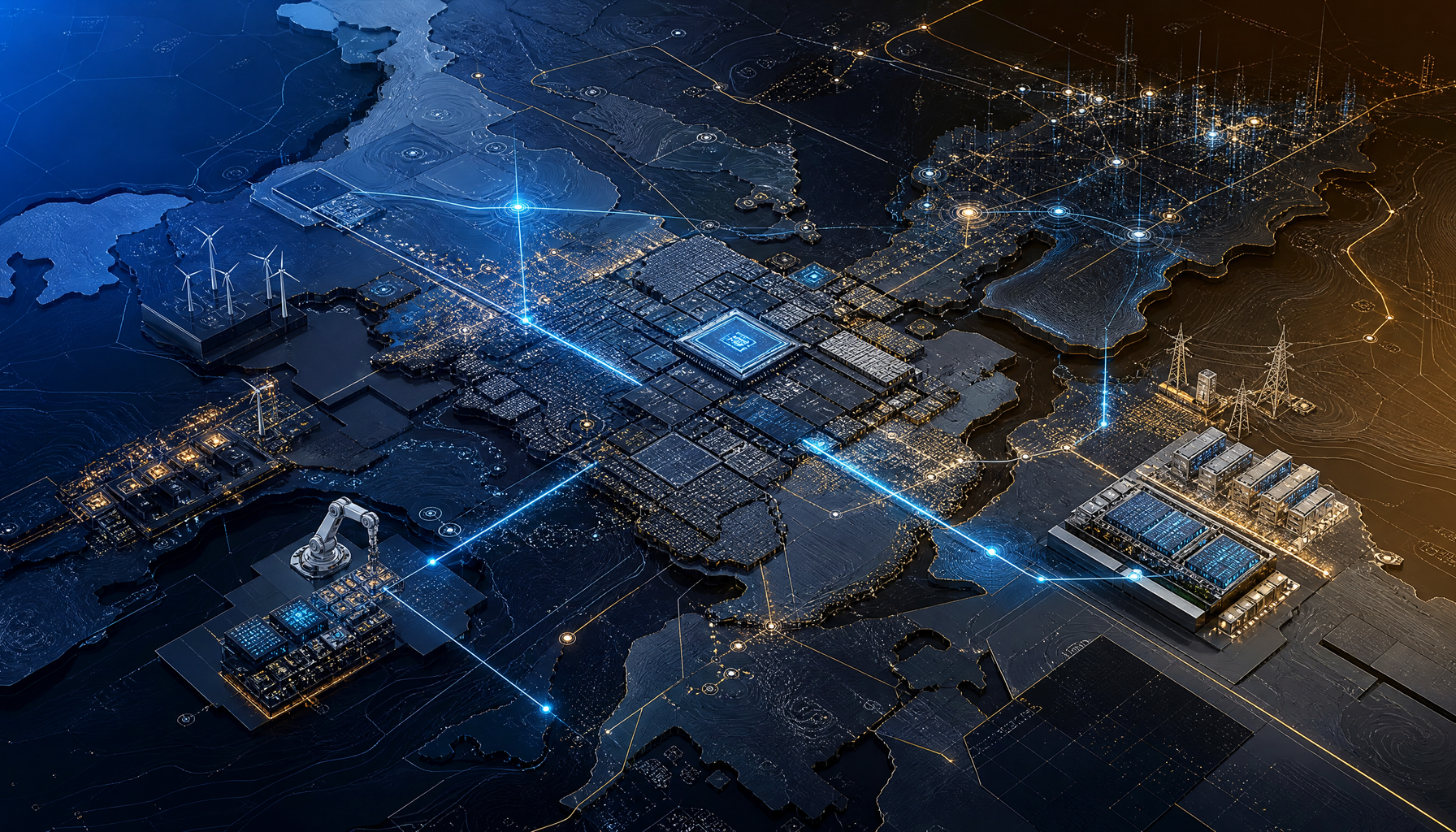
The most revealing AI development of the past two days was not a model launch, a new chatbot interface, or another skirmish over safety rules. It was South Korea laying out a public-private plan on a trillion-won scale that explicitly ties semiconductors, AI data centers, and physical AI to regional industrial buildout outside Seoul. The interesting shift is not simply the size of the ambition. It is the structure of the ambition. AI policy is starting to look less like a debate over models and more like a debate over territory.
That matters because the AI market has now moved beyond the phase where governments could treat it as a software-regulation problem. If a state believes competitive advantage will come from chip supply, training capacity, robotics deployment, and data-center concentration, then AI ceases to be merely a technology sector. It becomes an infrastructure map. South Korean President Lee Jae Myung’s language made that logic unusually clear. In a second account from Yahoo Finance, Lee described semiconductors, physical AI, and AI data centers as the “triple axis” of a national leap forward. That is not the vocabulary of consumer-tech policy. It is the vocabulary of industrial systems design.
The plan’s regional dimension is what makes it strategically important. According to the reporting, the government is not just encouraging more investment in the abstract. It is trying to connect semiconductor production, AI infrastructure, and robotics-related industries across specific regions such as Honam, Chungcheong, and Yeongnam. In other words, the state is attempting to choreograph an AI production ecosystem with geographic intent. That is a different level of intervention from offering tax credits, subsidizing compute, or tightening export controls. It implies that national AI strength will be determined partly by whether governments can decide where the stack physically lives.
This is where the story becomes more interesting than a giant spending headline. For the last year, many policymakers approached AI through three familiar lenses: safety, labor disruption, and international competition. South Korea’s move suggests a fourth lens is taking precedence. The real contest may be over whether countries can create dense, self-reinforcing industrial zones where memory, power, cooling, networking, robotics, and software talent all compound one another. If that is right, then AI leadership will not belong only to whoever builds the best model. It will belong to whoever assembles the most durable operating geography.
The controversy around the announcement makes the same point from the opposite direction. Critics of the project reportedly argued that semiconductor investment cannot be allocated mainly on regional-development grounds because the economics still depend on access to electricity, water, skilled labor, and supplier networks. That objection is analytically useful. It shows that AI industrial policy is colliding with physical constraints earlier than many governments expected. Every country now wants frontier capacity, but not every region can support the logistics of making that capacity work at scale.
That tension is likely to define the next round of AI nationalism. It is easy to announce data centers. It is much harder to secure power, move components, train the workforce, and persuade major private actors that the chosen sites are economically rational. South Korea may succeed precisely because it is trying to bind large incumbents such as Samsung and SK Hynix into a broader state-led ecosystem. But even that model comes with risk. If the regional logic outruns the industrial logic, the result is not an AI cluster. It is a politically elegant bottleneck.
The bullish reading is that this is how serious AI states now have to think. Software advantage alone will not defend a country that lacks chips, energy, and deployment capacity. The bearish reading is that governments may overestimate how easily those ingredients can be relocated by policy decree.
Still, South Korea’s announcement clarifies something the market has been slow to admit. AI is no longer just an innovation race or a regulatory argument. It is becoming a land-use problem, a power-grid problem, and a supply-chain-location problem. The countries that understand that earliest may end up defining the next phase of the industry more decisively than the companies that simply release the next model.