 Written by Silvia Pavelli
A proposed 4D Labs app would let contributors capture real spaces, with the goal of preparing them for robotics simulation.
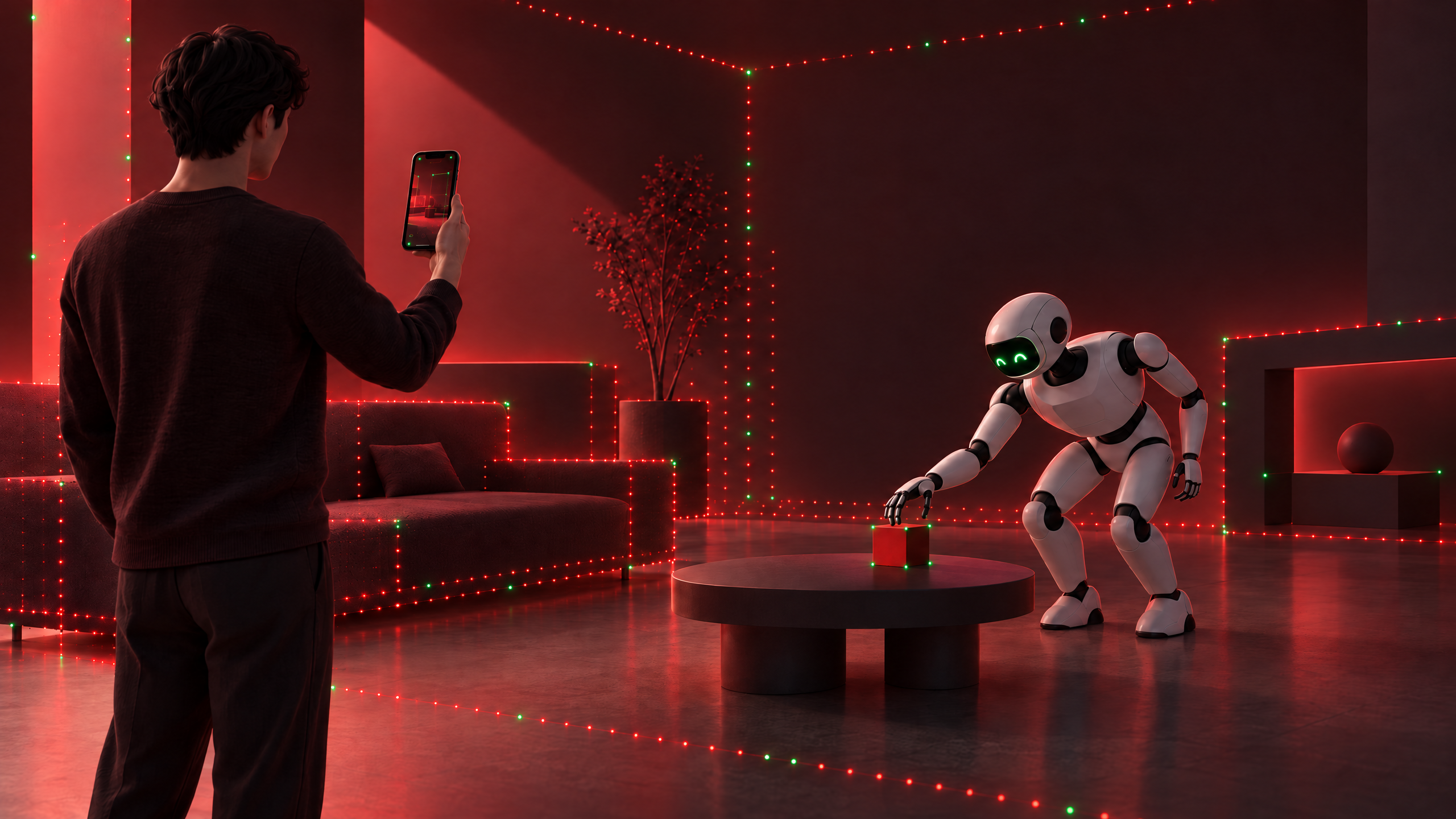
A living room, shop or factory could become part of a robot’s training environment under a proposal from 4D Labs. The company wants contributors to scan real spaces with smartphones, then process submissions into 3D environments that robotics developers could use in simulation.
The idea complements its proposed first-person sensing equipment and teleoperation, which focus more directly on interactions with objects. Mobile scanning could lower the equipment barrier to collecting scene data and increase the variety of spaces represented. Contributors would be rewarded for useful submissions, although the company has not specified earnings in the available materials.
The proposed workflow starts with images captured from multiple viewpoints. 4D Labs describes reconstructing scenes with techniques such as 3D Gaussian splatting, then cleaning and preparing the results for potential licensing to robotics companies. Its roadmap targets an app beta and data marketplace in December 2026; that is a plan, not evidence of a launched, widely used scanning service.
A visual reconstruction, however, is not automatically a physically faithful simulation environment. Hidden surfaces, moving objects and incomplete views can limit what a scan captures. A scene might look convincing without describing how an object moves or deforms when a robot touches it. Additional physical and interaction information may be needed before a robot can train meaningfully in that environment.
That is why scene data would sit alongside, rather than replace, information about movement, touch, force and task outcomes. The company’s wider strategy combines several collection methods and processing steps to make data more useful for training.
Privacy and permission are equally important. A home scan can capture people or personal belongings, while a factory scan could expose sensitive processes. Before data is shared, contributors and relevant site owners need clarity on consent, permitted uses, retention, access and deletion. The materials describe planned safeguards but do not establish which are already operational.
Useful tests would examine coverage, reconstruction quality and cost per usable scene—not just upload counts. A stronger test would compare robot performance with and without the data on a defined task. For 4D Labs, the opportunity is to open a wider collection channel; the challenge is proving that those scans become safe, usable and valuable training environments.