
 Written by David McMahon
If artificial intelligence creates enormous new wealth while displacing workers, democracies may be tempted to buy social peace with cash transfers. But a rival power that channels the same surplus into drones, autonomy, and military-industrial acceleration could force a harsher answer to the politics of post-work abundance.
The friendliest vision of advanced artificial intelligence is also one of the oldest political dreams: abundance without misery. In that future, AI systems automate a growing share of routine and cognitive labor, output rises, profits swell, and societies finally gain the economic slack to protect people from the shocks of technological change. Workers whose jobs are displaced are not abandoned. They receive a universal basic income, or some comparable social dividend, financed by the extraordinary productivity of machine intelligence. The economy becomes less dependent on wage labor, and human beings gain more security, more time, and perhaps more freedom.
It is an attractive idea. It is also incomplete.
The central weakness in the utopian version of AI abundance is that it assumes the main political problem is domestic distribution. What happens inside a country certainly matters. But what happens between countries may matter just as much. If AI generates vast economic surplus, there is no guarantee that states will spend that surplus on social peace. Some will. Others may channel it into military capability, strategic industry, intelligence systems, drone swarms, logistics automation, and coercive state power. In that world, a nation that uses AI profits to stabilize the losers of automation may find itself strategically exposed to a rival that uses the same profits to build an AI-enabled war machine.
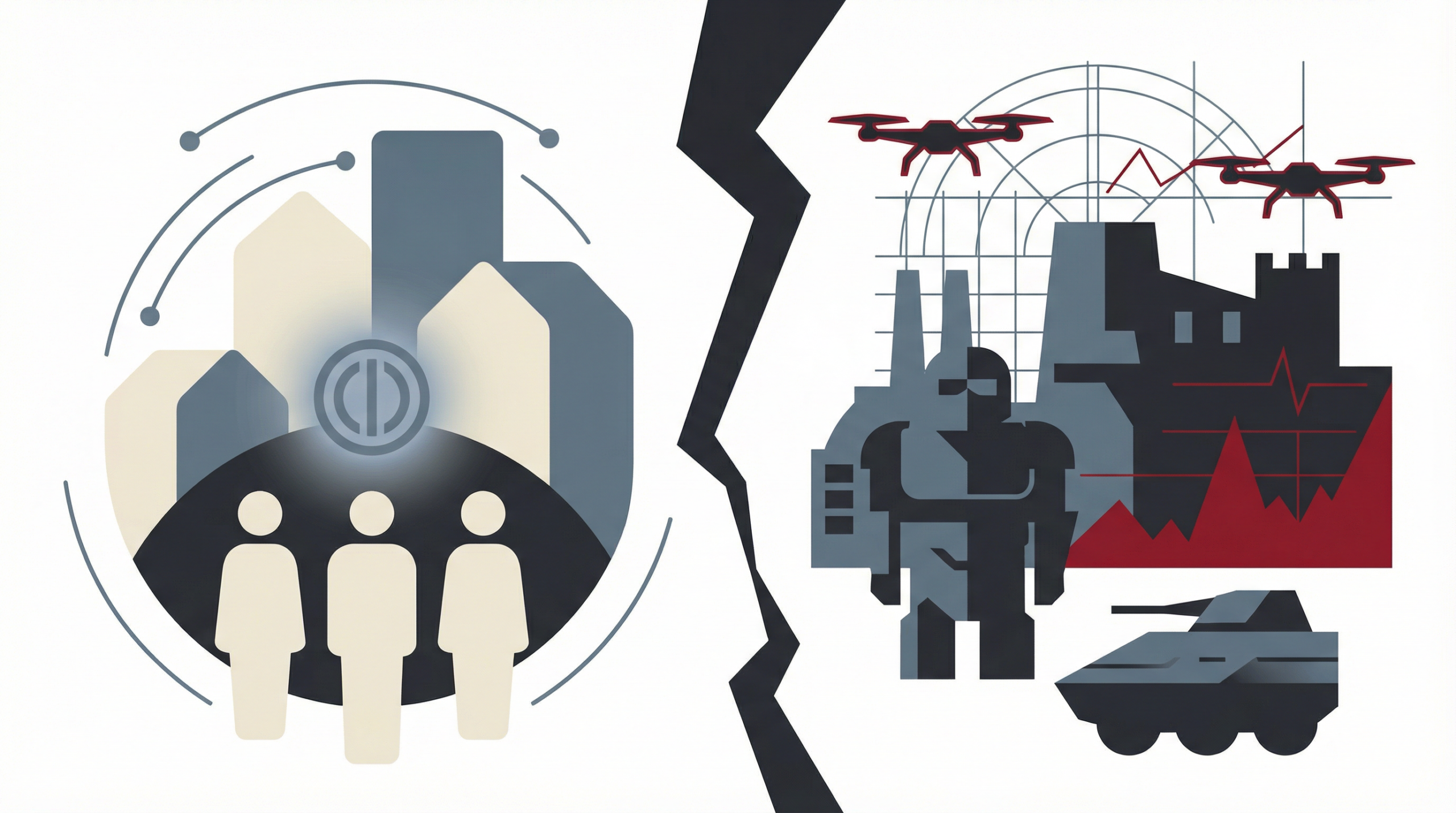
That is the real question behind the phrase AI UBI or AI Sparta. It is not simply a clash between generosity and cruelty. It is a clash between two uses of technological surplus: one designed to reduce internal stress, and another designed to maximize external power.
The domestic case for AI dividends
There are good reasons the UBI future has intuitive appeal. The OECD says rapid developments in AI are already having potentially far-reaching consequences for work and that there is an urgent need for policies allowing everyone to benefit while also addressing the risks. The IMF likewise argues that policy choices will determine whether the gains from AI are broadly shared and notes that nearly 40 percent of global jobs are exposed to AI-driven change. In other words, the distributional question is not speculative. It is already here.
“Policy choices made today can turn disruption into opportunity.” — IMF
If AI displaces workers faster than economies can absorb them into new roles, governments will face pressure to cushion the blow. Universal basic income is one possible answer. Even where policymakers do not adopt a formal UBI, they may move toward AI dividends, wage insurance, negative income tax models, expanded unemployment protection, or direct transfers financed by taxing automated production and AI-enabled rents. The moral logic is straightforward: if machines make society richer while reducing the value of human labor in key sectors, some part of that gain should flow back to citizens.
That logic becomes stronger if AI concentrates income at the top. A 2025 NBER paper by Susan Athey and Fiona Scott Morton argues that the owners of AI may be able to capture a large share of the surplus AI creates. That point matters because it suggests AI abundance may not naturally trickle down through wages or competition. Without deliberate redistribution, the result may be a more productive but less politically stable society.
Why surplus does not automatically become welfare
Still, it is a mistake to imagine that higher productivity automatically produces a kinder social contract. Surplus is never self-interpreting. It is always allocated through politics, institutions, and power. A state can use new wealth to reduce inequality, but it can also use new wealth to deepen surveillance, fortify borders, subsidize strategic industry, or expand military reach. The existence of an AI dividend does not tell us who will receive it.
This is where the geopolitical problem enters. Once AI is understood not only as an economic technology but also as a military and strategic one, governments face a sharper trade-off. Money spent on social pacification is money not spent on deterrence, defense production, compute infrastructure, autonomous systems, and national power. A society can choose fairness at home, but it cannot assume competitors will make the same choice.
The competition is no longer hypothetical. The Belfer Center notes that states have already begun integrating sophisticated AI systems into military postures, diplomatic toolkits, and decision-making processes, and reports that global military spending on AI was estimated to have risen from $4.6 billion to $9.2 billion between 2022 and 2023, with a projected rise to $38.8 billion by 2028. The Brennan Center reports that the U.S. Department of Defense has allocated at least $75 billion to AI-driven programs since 2016, requested $13.4 billion for autonomous and related systems for 2026, and may spend as much as $9 billion on data centers and computing capabilities customized for military needs.
Those figures do not prove that an AI arms race is inevitable. But they do show that major states already see AI as an instrument of hard power. The money is moving. The institutional machinery is forming. The military use case is not some dystopian afterthought to the economic one. It is developing in parallel.
Two futures for the same AI surplus
| Path | Political purpose | Near-term appeal | Strategic risk |
| AI UBI | Preserve domestic stability by redistributing gains from automation | Reduces social unrest, cushions displaced workers, and makes the AI transition politically tolerable | Can leave a state underinvested in deterrence or strategic industry if rivals convert surplus into hard power |
| AI Sparta | Convert AI-driven productivity into military, industrial, and coercive advantage | Strengthens deterrence, defense capacity, and geopolitical leverage | Can hollow out domestic legitimacy, intensify repression, and normalize permanent mobilization |
The danger is not merely that one country chooses the harsher path. The danger is that the existence of such a country changes the incentives facing everyone else. A single expansionist power can force more restrained societies to reallocate their own resources. This is one of the oldest realities of international politics: states do not choose in a vacuum. They choose under pressure, in competition, and often in fear.
That pressure becomes more intense if AI changes the economics of military production. AI may help states process intelligence faster, automate logistics, lower the cost of certain weapons systems, improve targeting, accelerate planning, and expand the autonomy of drones and surveillance systems. If so, the same technologies that enable civilian abundance may also lower the marginal cost of coercion. A government that sees history as a contest for relative advantage will not look at AI and think first about leisure. It will think about mobilization.
The strategic asymmetry problem
This creates a deep asymmetry for liberal democracies. Open societies are more likely to debate fairness, worker dignity, and the social legitimacy of automation. They are also more likely to face domestic pressure to compensate those displaced by AI. That is a virtue. But it can become a vulnerability if rival states either suppress domestic dissent or define national legitimacy in terms of expansion, order, and power projection.
A humane democracy may ask, “How do we share the gains from AI?” A harder regime may ask, “How do we turn these gains into dominance before our rivals do?” The second question is strategically brutal, but it may be rewarded in a conflictual international system.
This is why the politics of post-work cannot be separated from deterrence. A country that funds AI-enabled welfare while allowing its industrial base, defense production, and strategic computing capacity to weaken may be making a temporary moral achievement and a long-term geopolitical mistake. If a rival can transform AI profits into autonomous weapons, battlefield decision systems, state surveillance, and military logistics, then redistribution without strategic capacity may amount to disarmament by another name.
That does not mean the militarized state is destined to win. History is not so tidy. Rich, innovative societies with high legitimacy can be resilient and powerful. Domestic cohesion itself is a strategic asset. A population that trusts its institutions may outlast one ruled only by coercion. But the optimistic case requires more than faith in prosperity. It requires serious statecraft.
The false comfort of assuming utopia is efficient
There is another reason the UBI-only imagination can be misleading: it treats welfare as the natural endpoint of abundance. Yet many of the most consequential technological revolutions have strengthened states before they liberated citizens. Railways moved armies before they unified labor markets. Industrial chemistry fed populations and armed militaries. Nuclear physics promised limitless energy and produced nuclear deterrence. Technologies with civilian benefits often become decisive first where power is most concentrated.
AI is especially likely to follow this pattern because it sits at the junction of economic productivity, information control, and military coordination. It can raise output, but it can also centralize decision-making, expand surveillance, and increase the tempo of coercive operations. In strategic terms, AI is not merely a labor-saving device. It is a regime-strengthening technology.
That is why the phrase AI Sparta matters. It is not a prediction that every state will become an armed camp. It is a warning that AI abundance may empower disciplined, militarized, or expansionist states at least as readily as it empowers post-work democracies. If one polity chooses a generous settlement for displaced workers while another chooses conquest, the second polity may impose the terms of reality on the first.
What a serious AI social contract would require
The conclusion is not that UBI is foolish. Nor is it that social spending and military preparedness are mutually exclusive in every case. The real lesson is that any serious AI social contract must be geopolitical from the beginning.
A sustainable democratic response to AI would need to do at least three things at once. It would have to preserve social legitimacy at home by ensuring that the gains from automation are widely shared. It would have to maintain enough industrial and technological depth to avoid strategic dependence on rivals. And it would have to think clearly about deterrence in a world where AI lowers the cost and raises the precision of coercive power. The question is not whether societies can afford redistribution. It is whether they can afford redistribution without strategy.
That is the choice hidden inside the rhetoric of AI utopia. If the productivity gains are large enough, then perhaps the best societies will be able to fund both a generous civic dividend and a credible defense. But if trade-offs bite early, then states will reveal what they fear most: domestic unrest or foreign subordination.
The dream of AI abundance says citizens liberated from work will finally share in the fruits of automation. The darker possibility is that those fruits will be harvested first by states that know exactly what they want to do with surplus: centralize it, weaponize it, and use it before others can respond.
In that contest, the future may not be decided by which society imagines the kinder utopia. It may be decided by which one best understands that utopia still lives in history, and history has never stopped being geopolitical.